





I’ve eaten a lot of meals. Some were perfect, some were disasters, some were eaten in sukoon standing by the sink, and some were eaten alone, despite being in a room full of people. Chips and cheers, curries and chaos, laughter and lulls… all of it, somehow, lands on the plate that knew exactly who I was that day.
Every spill, every bite, every swoosh has meticulously left a mark, not on the plate, but on me, and who I’ve become.
Plates have personalities. They can be bold or boring, serious or silly, commanding or comforting. Some demand respect. Some invite indulgence. Some let you off easy. And because of that, the plate I choose — consciously or unconsciously — becomes a mirror into me.
Before you even notice it, they are carrying rules. The sweet served first, the spicy comes second, the balance of proportion comes next, and the melodrama of expectations of who is handed the plate first, circles just like the plate/ circles in silence.
While around the world in a plate might be too large a subject to cover. In India, across the multilingual, multicultural states of our country; plates change meaning every few kilometres — in material and in moments. Much like the banana leaf seen as reverence. Sal leaf seen as casual convenience. Stainless steel seen as comfort, routine, permission. The stoneware? Befitting for the creative. Hand-me-down china? An era to recall. The dilapidated steel thalis? Somehow more honest, more generous, more permissive. The everyday borosilicate — occasional, but not so convenient. The melamine — cheap cousin of the La Opala.
And here’s the thing: it’s not just food that lands on them. It’s my mood, my choices, my identity — packed in portions like a seventeen course meal I didn’t sign up for.

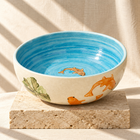
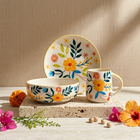
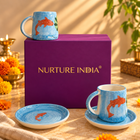
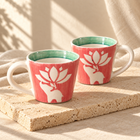
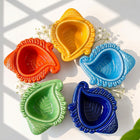
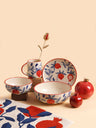
It is to say, almost vehemently that, none of us pick plates randomly. On the days I need comfort, I reach for my compartmentalised steel plate. Days I want to perform, I reach for my Kansa plates and katories. Days I want beauty, I pick the one we make at Nurture India that adds colour to my table. Days I just want to disappear, I pick out the one closest on the crockery shelf- for its familiarity mixed with finery.
Every single choice says something about who I am, or at least, who I want to be at that very moment.
And if you are still thinking, that this is all a plate carries, you still haven’t let it consume you. Formal meals taught me that plates signal hierarchy: different courses, different rules, different expectations. But my most honest meals? Those are the ones where I pile everything, eat fast, and wash immediately — alone, unapologetic, uncurated. Both extremes coexist, and both feel real. Both feel like me.
If, like me, you’ve always believed that dress, beauty, and food were the only acceptable forms of self-expression being endlessly reeled in modern life, you’d be surprised by what a mood-shifter it is to express yourself on a plate. Feeling toasty? Plate it. Feeling feisty? Add chilli. Feeling scrambled? Plate it, already.
Yes, food and plating have always shared a long-standing intersection — for culinary delight, technique, and taste. But I’d argue this isn’t just a chef’s prerogative or a professional performance. It’s deeply personal.
My husband, a complete novice in the kitchen, uses plating to make me smile. A burger served with ketchup spread into a smiley face is quite literally the best he can do — and somehow, it works. My mother, supremely intuitive, adds an extra dollop of ghee just before serving, letting it quietly run into the crevices of the plate. That’s her language. That’s love.
Plating is a love language spoken without words.
Shown in actions.
And held, patiently, by the plate — observer of all this madness

Leave a comment
All comments are moderated before being published.
This site is protected by hCaptcha and the hCaptcha Privacy Policy and Terms of Service apply.